
Formats and completed examples
RCM Self-Invoice Format
Download an RCM self-invoice layout in Word or PDF for an applicable recipient-issued invoice. It records the supplier, recipient, supply receipt date, value and recipient tax; confirm that the specific self-invoicing requirement applies first.
Recipients preparing records for an applicable reverse-charge transaction with tax review.
On this page
At a glance
- The recipient issues this document only where the relevant self-invoicing conditions apply.
- The example shows INR 1,000 supply value and INR 180 illustrative recipient tax.
- Word amounts are manual; the files do not calculate applicability, deadlines or tax payments.
Download your format
Files are in English. Choose the version you need below.
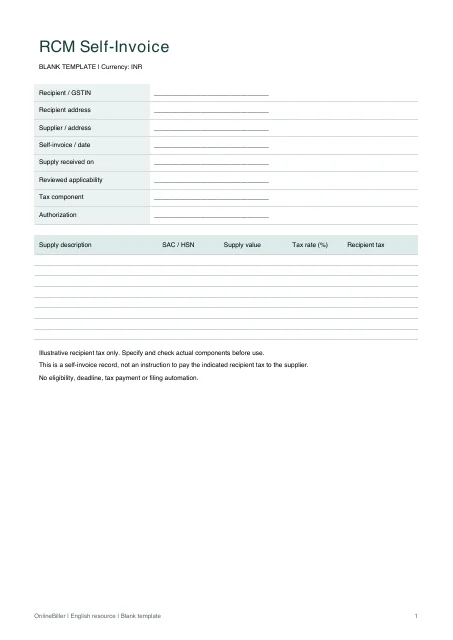
Blank template — DOCX
Editable Word document. Enter and check amounts manually; totals do not recalculate.
Download DOCX38 KB · A4 · Enter and check totals yourselfBlank template — PDF
Print-ready fixed document. It has no fillable form fields.
 View PDF previewDownload PDF7 KB · A4 · No calculations needed
Worked example — DOCX
Editable Word document. Enter and check amounts manually; totals do not recalculate.
Download DOCX38 KB · A4 · Enter and check totals yourselfWorked example — PDF
Print-ready fixed document. It has no fillable form fields.
 View PDF previewDownload PDF6 KB · A4 · No calculations needed
A completed example
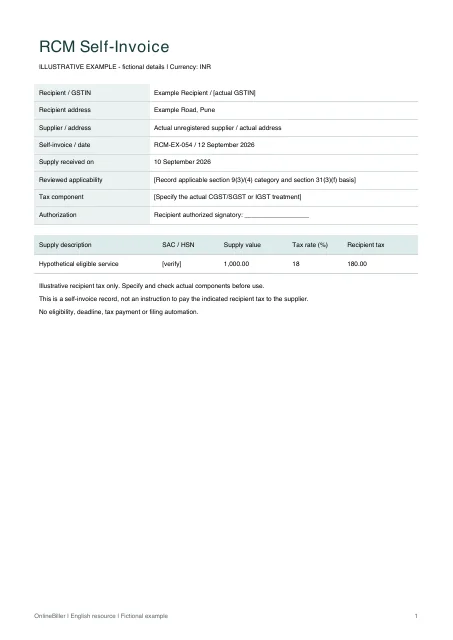
| Supply description | SAC / HSN | Supply value | Tax rate (%) | Recipient tax |
|---|---|---|---|---|
| Hypothetical eligible service | [verify] | 1,000.00 | 18 | 180.00 |
Fictional example. Use the figures only to follow the document and calculation.
What to fill in
| Field | What to enter | Example |
|---|---|---|
| Recipient issuing the document | The recipient prepares this self-invoice where the relevant requirement applies; do not reverse the supplier and recipient roles. | Example Recipient / actual GSTIN |
| Supplier and eligibility | Record actual supplier particulars and the reviewed basis for recipient self-invoicing. An unregistered purchase alone is not enough. | Actual unregistered supplier details |
| Dates and references | Keep the supply receipt date and self-invoice date visible. Review the applicable timing requirement. | Receipt 10 September; document 12 September 2026 |
| Tax and payment | Distinguish the value owed to the supplier from tax for which the recipient is liable. | Supply value INR 1,000; indicated tax INR 180 |
Check the requirement before creating a file
Section 31(3)(f) concerns recipient invoicing in the relevant reverse-charge circumstances. It is not a rule that every purchase from an unregistered supplier requires this document. Confirm the actual category and the recipient’s liability before using the layout.
Keep receipt and document dates separate
Notification 20/2024 inserted Rule 47A, effective 1 November 2024, prescribing thirty days from receipt for the recipient invoice required under section 31(3)(f) where liable under section 9(3) or 9(4). Review the applicable rule and actual transaction rather than using the example dates as a deadline calculator.
A self-invoice is not a payment voucher
The example shows INR 1,000 supply value and INR 180 illustrative recipient tax. That tax is not an instruction to pay INR 180 to the supplier. A payment voucher, tax payment and return record serve different purposes and are not generated by this file.
- Confirm and retain the reviewed applicability basis.
- Record supplier, recipient, supply receipt and document details accurately.
- Replace the illustrative rate and specify the actual tax components.
- Review authorization, timing and the separate payment/reporting records.
Complete the reviewed transaction details
Use Word to replace the supplier, recipient, supply dates, classification, values and tax-component placeholders. Check all amounts manually and keep the applicability record with the document. The PDFs are fixed blank and worked examples; they do not issue a statutory payment voucher.
Distinguish the three document roles
| Document | Who prepares it | What to check |
|---|---|---|
| Recipient self-invoice | Recipient where the specific requirement applies | Relevant supplier status, applicability, supply receipt and invoice details |
| Supplier invoice with reverse-charge indication | Supplier in the applicable supplier-invoicing situation | Do not replace it merely because reverse charge is mentioned |
| Statutory payment voucher | Recipient where the specific payment-voucher requirement applies | Separate payment-stage particulars; an ordinary cash voucher is not a substitute |
The downloads on this page cover only the recipient self-invoice layout; they do not automatically generate the other documents.
Common questions
Does this apply to every unregistered purchase?
No. The relevant reverse-charge and recipient-invoicing conditions must apply; supplier registration status alone does not determine the answer.
Can I use the 18% example as the actual rate?
No. It demonstrates INR 1,000 × 18% = INR 180 only. Review the actual classification, rate and tax components.
Does the template calculate deadlines or pay tax?
No. The manual files record information; they do not decide applicability, calculate deadlines, pay tax or file returns.
Sources and further reading
- CGST Act section 31(3)(f) and (g) — Recipient invoice and separate payment-voucher document roles.
- Notification 20/2024 — Rule 47A — Effective 1 November 2024: bounded timing reference for the applicable recipient invoice, not a blanket unregistered-purchase rule.
Sources checked: .